
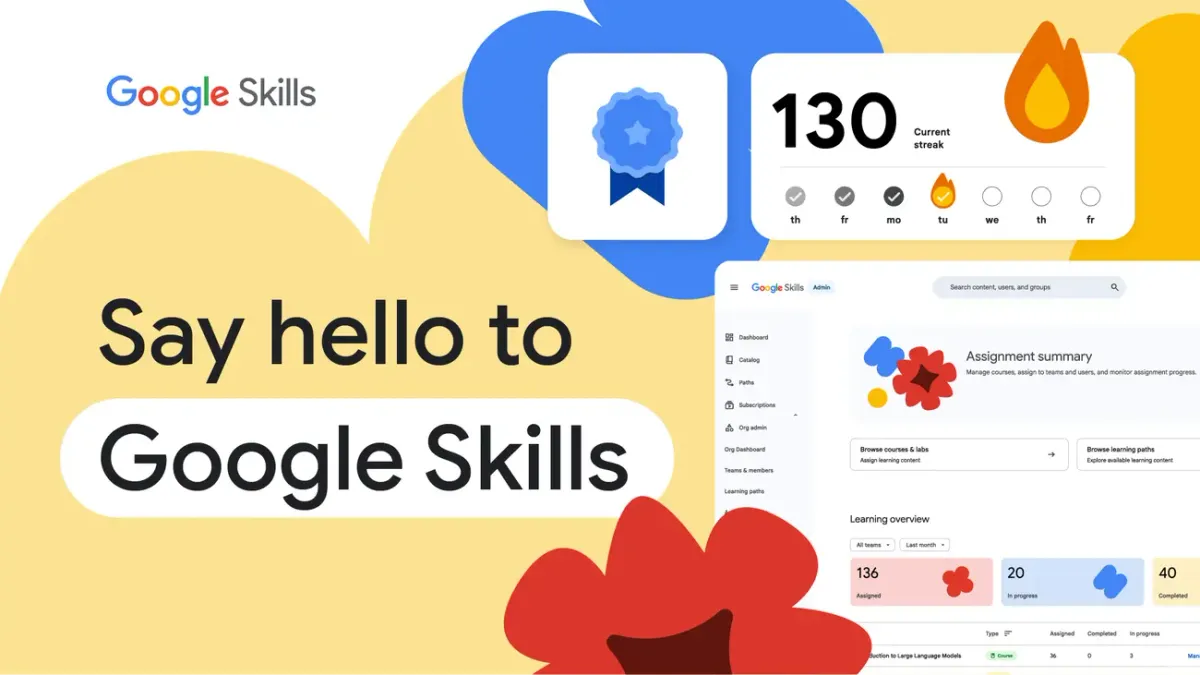
In October 2025, Google launched Google Skills, a unified AI learning platform that brings together nearly 3,000 courses and hands-on labs from across Google’s ecosystem—including Google Cloud, Google DeepMind, Grow with Google, and Google for Education. The platform represents Google’s most ambitious effort yet to democratize AI education, featuring Gemini Code Assist integration in over 20 labs and a gamified learning experience designed to make artificial intelligence accessible to everyone from beginners to advanced practitioners.
The Unified Learning Hub
Consolidating Google’s Educational Resources
Google Skills addresses a long-standing challenge: Google’s educational content has been scattered across multiple platforms, making it difficult for learners to find comprehensive, structured AI learning paths. The new platform consolidates:
- Google Cloud Skills Boost: Cloud computing and AI/ML courses
- Google DeepMind: Cutting-edge AI research and methodologies
- Grow with Google: Career-focused digital skills training
- Google for Education: Academic and institutional learning resources
The Result: A single destination with nearly 3,000 courses, eliminating the need to navigate multiple sites and create separate accounts.
Content Scope and Depth
The platform covers the full spectrum of AI education:
Foundational Topics:
- Introduction to Machine Learning
- Neural Network Basics
- Data Science Fundamentals
- Python Programming for AI
Advanced Specializations:
- Large Language Model Development
- Computer Vision and Image Recognition
- Natural Language Processing
- Reinforcement Learning
- Generative AI Architectures
Applied Skills:
- AI for Business Leaders
- Ethical AI Development
- AI Product Management
- MLOps and Model Deployment
Gemini Code Assist: Learning by Doing
Integrated Coding Assistant
The standout feature of Google Skills is Gemini Code Assist, Google’s AI-powered coding assistant, now deeply integrated into the learning experience. This marks a significant evolution from traditional online courses where learners code in isolation.
Current Integration:
- 20+ hands-on labs currently feature Gemini Code Assist
- All relevant future labs will include the assistant
- Real-time coding help without leaving the learning environment
How Gemini Code Assist Enhances Learning
1. Contextual Code Suggestions
As learners work through coding exercises, Gemini provides:
- Autocomplete: Intelligent code completion based on the lab’s objectives
- Function suggestions: Recommendations for appropriate libraries and methods
- Error detection: Real-time identification of syntax and logic errors
2. Interactive Explanations
Gemini goes beyond simple code generation:
- Explain code: Learners can highlight any code block and ask “What does this do?”
- Debug assistance: When code fails, Gemini explains why and suggests fixes
- Best practices: Recommendations for writing cleaner, more efficient code
3. Learning Reinforcement
The assistant adapts to the learner’s level:
- Hints, not solutions: Provides guidance without giving away answers
- Progressive difficulty: Offers more or less help based on learner progress
- Conceptual connections: Links current work to broader AI concepts
Example Use Case: Machine Learning Lab
Imagine a learner working through a “Build Your First Neural Network” lab:
- Stuck on data preprocessing? Ask Gemini: “How should I normalize this dataset?”
- Unsure about layer architecture? Gemini suggests: “For image classification, try a convolutional layer”
- Model not converging? Gemini diagnoses: “Your learning rate may be too high—try 0.001”
This integrated assistance accelerates learning while maintaining the challenge necessary for skill development.
Gamification: Making AI Education Engaging
Achievement System
Google Skills introduces a comprehensive gamification layer designed to maintain motivation and track progress:
Badges:
- Course completion badges: Recognize finishing individual courses
- Skill pathway badges: Awarded for completing themed learning tracks
- Mastery badges: Earned through advanced assessments
Points System:
- Earn points for completing lessons, labs, and quizzes
- Bonus points for consistent daily learning
- Leaderboards (optional) for competitive learners
Learning Streaks
The platform encourages consistent study habits:
- Daily streaks: Track consecutive days of learning activity
- Weekly goals: Set and achieve personalized learning targets
- Progress visualization: Visual representation of skill development over time
Social Learning Features
Google Skills incorporates community elements:
- Study groups: Form or join groups focused on specific topics
- Peer reviews: Submit projects for constructive feedback
- Discussion forums: Ask questions and share insights with fellow learners
Workspace Integration: AI in Action
Google Workspace Updates (October 2025)
Alongside Google Skills, Google announced major AI enhancements to Workspace, demonstrating how AI education translates into practical tools:
Google Sheets:
- Multi-step automation: Gemini now handles complex, multi-step tasks from a single prompt
- Example: “Delete archived rows, apply conditional formatting, and add a ‘Total’ column”
- Previously: Each step required a separate prompt or manual execution
- Impact: Dramatic productivity improvement for data-heavy workflows
Google Vids:
- Veo 3.1 integration: Google’s latest video generation model
- Automatic video creation: Generate presentations with AI-created footage
- Storyboard assistance: AI suggests video narratives based on content
Google Slides:
- Animated presentations: Veo 3.1 creates custom animations and transitions
- Visual storytelling: Transform static slides into dynamic presentations
Google Drive (Mobile):
- Document summarization: AI-powered summaries on iOS and Android
- Quick insights: Get key takeaways without opening full documents
- Voice queries: Ask Drive about document contents using natural language
Gemini Enterprise: The Business Play
Google’s October 2025 Workspace updates center on Gemini Enterprise, positioning AI as essential for business collaboration:
Key Features:
- Company knowledge integration: Gemini accesses internal documents and data
- Collaborative agents: AI assistants that work alongside teams
- Automated workflows: Routine tasks handled by AI
Competitive Positioning:
- vs. Microsoft Copilot: Google emphasizes deeper integration and lower cost
- vs. OpenAI ChatGPT: Highlights enterprise security and data privacy
- vs. Anthropic Claude: Focuses on Workspace ecosystem advantage
Target Audiences
Individual Learners
Google Skills serves self-directed learners seeking AI expertise:
Career Switchers:
- Goal: Transition into AI/ML roles
- Path: Foundational courses → Specialization tracks → Certification
- Support: Career guidance and job-matching resources
Current Tech Professionals:
- Goal: Add AI skills to existing expertise
- Path: Skip basics, dive into advanced topics
- Support: Integration with LinkedIn for profile enhancement
Students and Academics:
- Goal: Complement formal education
- Path: Align with university curricula
- Support: Academic credit partnerships (select institutions)
Organizations
Google Skills also targets institutional learning:
Corporate Training:
- Team accounts: Manage employee learning at scale
- Custom pathways: Curate courses for specific roles
- Progress dashboards: Track team skill development
Educational Institutions:
- Classroom integration: Use Google Skills as supplementary material
- Curriculum alignment: Courses map to standard CS/AI programs
- Educator resources: Teaching guides and assessment tools
Pricing and Access
Free Tier
The majority of Google Skills content is free, including:
- All foundational courses
- Most hands-on labs
- Gemini Code Assist in learning environments
- Community features (forums, study groups)
Paid Options
Advanced content and features require payment:
Individual Subscriptions:
- Google Skills Pro ($29/month): Access to all premium courses and priority Gemini assistance
- Certification Exams (199): Professional credentials for completed pathways
Enterprise Licensing:
- Custom pricing: Based on team size and feature requirements
- Admin dashboards: Track and manage team learning
- Dedicated support: Onboarding and training assistance
Competitive Landscape
How Google Skills Compares
vs. Coursera/Udemy:
- Advantage: Integrated AI assistant, hands-on Google Cloud labs
- Disadvantage: Narrower focus (primarily AI, less breadth across all tech topics)
vs. LinkedIn Learning:
- Advantage: Deeper technical content, actual coding environments
- Disadvantage: Less emphasis on soft skills and business applications
vs. Codecademy:
- Advantage: Cutting-edge AI content from DeepMind researchers
- Disadvantage: Newer platform with less established community
vs. DataCamp:
- Advantage: Gemini integration provides superior coding assistance
- Disadvantage: Primarily focused on AI/ML, less comprehensive data science coverage
Market Opportunity
The AI education market is experiencing explosive growth:
- Market size: Estimated 50 billion by 2030
- Demand drivers: AI transformation across industries, talent shortage
- Google’s position: Leverage brand trust and technical authority
Challenges and Criticisms
Content Quality Consistency
With nearly 3,000 courses from multiple sources:
- Variable quality: Not all content maintains DeepMind-level rigor
- Redundancy: Some topics covered by multiple courses with varying approaches
- Outdated material: Fast-moving AI field makes some content stale quickly
Gemini Code Assist Limitations
While impressive, the integrated assistant has constraints:
- Not always accurate: Can suggest incorrect code or approaches
- Over-reliance risk: Learners may depend too heavily on AI assistance
- Limited languages: Primarily strong in Python, weaker in other languages
Privacy Concerns
Code written in Google Skills environments raises questions:
- Data usage: Is learner code used to train Gemini models?
- Intellectual property: Who owns code developed in Google’s environment?
- Corporate security: Can enterprises safely train employees without exposing proprietary knowledge?
Google states that learner code is not used for model training by default, with explicit opt-in required—but concerns persist.
The Broader Strategy
Google’s AI Ecosystem Play
Google Skills is not a standalone product but part of a comprehensive AI strategy:
1. Education → Adoption Pipeline:
- Learn AI on Google Skills
- Build projects on Google Cloud
- Deploy with Vertex AI
- Use Gemini for Workspace productivity
2. Developer Loyalty:
- Train on Google’s tools and frameworks
- Develop muscle memory for Google Cloud workflows
- Increase switching costs to competitors
3. Enterprise Penetration:
- Upskill employees on Google Skills
- Adopt Gemini Enterprise for collaboration
- Migrate workloads to Google Cloud
Competing with Microsoft and Amazon
Google trails Microsoft and Amazon in cloud market share:
- Azure: ~25% market share
- AWS: ~32% market share
- Google Cloud: ~11% market share
Google Skills aims to close this gap by:
- Creating Google-trained AI talent: Developers proficient in Google tools
- Demonstrating AI leadership: Position Google as the AI innovation leader
- Building ecosystem lock-in: Integration across learning, development, and deployment
Real-World Impact
Early Success Stories
Google has shared initial outcomes from beta testers:
Erika, Career Switcher:
- Background: Former marketing professional
- Journey: Completed 12 Google Skills courses over 6 months
- Outcome: Landed ML engineer role at tech startup
- Key: Gemini Code Assist helped overcome coding challenges
TechCorp Team:
- Challenge: Upskill 50-person engineering team on generative AI
- Solution: Custom Google Skills learning paths
- Result: Team shipped first LLM-powered feature 3 months ahead of schedule
Academic Partnerships
Google has partnered with universities to integrate Google Skills:
- Stanford University: Supplementary resource for CS courses
- MIT: Collaboration on advanced AI curriculum
- State university systems: Free access for computer science students
The Road Ahead
Planned Enhancements (2026)
Google has previewed upcoming features:
Personalized Learning Paths:
- AI-driven recommendations: Gemini suggests courses based on goals and progress
- Adaptive difficulty: Content adjusts to learner’s pace and skill level
Expanded Gemini Integration:
- All labs: Gemini Code Assist in every hands-on environment
- Multimodal assistance: Visual explanations, video tutorials, interactive diagrams
Industry Certifications:
- Recognized credentials: Partnerships with tech companies to acknowledge Google Skills certificates
- Stackable credentials: Combine certificates into professional designations
Mobile App:
- iOS and Android: Learn on the go with mobile-optimized content
- Offline access: Download courses for internet-free learning
Long-Term Vision
Google Skills aims to become the default AI education platform, supporting learners from complete beginners through to expert practitioners. Success will be measured by:
- Learner outcomes: Job placements, career advancement, skill acquisition
- Enterprise adoption: Corporate training programs built on Google Skills
- Ecosystem growth: Developers building on Google Cloud after learning on Google Skills
Conclusion: Education as Competitive Advantage
Google Skills represents a strategic bet: that AI education is the foundation of AI adoption. By creating a world-class learning platform, Google aims to:
- Build brand loyalty among the next generation of AI practitioners
- Drive Google Cloud adoption through familiar tools and workflows
- Compete with Microsoft and AWS by developing Google-native talent
- Democratize AI while advancing Google’s commercial interests
With 3,000 courses, Gemini Code Assist integration, and gamified learning, Google Skills is positioned to become a cornerstone of AI education—benefiting learners while strengthening Google’s competitive position in the AI infrastructure war.
The real test will be whether Google Skills delivers on its promise: making AI expertise accessible to millions while maintaining the quality and rigor necessary for real-world application.
Access Google Skills: Free at skills.google.com
Pricing:
- Free: Most courses and labs
- Pro ($29/mo): Premium content and priority support
- Certifications: 199 per exam
Stay updated on the latest AI education and developer tools at AI Breaking.