
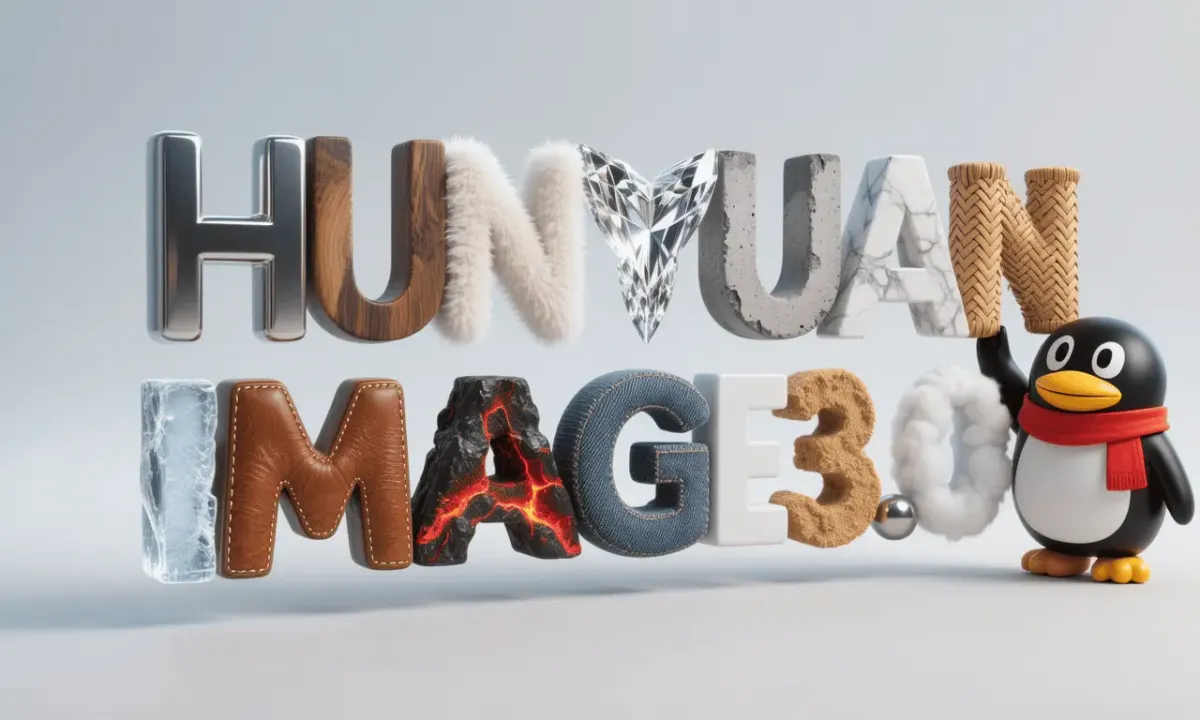
In early October 2025, Tencent’s Hunyuan Image 3.0 secured the #1 position on LMArena’s text-to-image leaderboard, surpassing Google DeepMind’s highly-acclaimed “Nano Banana” (Gemini 2.5 Flash Image). With 80 billion parameters, Hunyuan Image 3.0 becomes the world’s largest open-source image generation model, marking a pivotal moment in China’s AI competitiveness. Released on September 28, 2025, this model not only matches flagship closed-source competitors—it beats them in user preference tests while remaining completely free and open-source.
The Leaderboard Victory
LMArena: The Blind Test Standard
LMArena (formerly LMSYS Arena) is the gold standard for AI model evaluation, originally created by researchers at UC Berkeley. Its text-to-image leaderboard ranks models based on blind user preference tests: users compare two anonymously generated images and choose which one better matches the prompt—no brand bias, just quality.
October 2025: The Rankings Shift
As of Saturday, October 5, 2025:
- #1: Tencent Hunyuan Image 3.0 (open-source, 80B parameters)
- #2: Google Nano Banana (Gemini 2.5 Flash Image, closed-source)
- Other top contenders: Midjourney, DALL-E 3, Flux, Stable Diffusion variants
Significance: This marks the first time a Chinese open-source model has topped the global text-to-image leaderboard, beating not only Google but also established players like Midjourney and OpenAI.
What Dethroned Nano Banana
Google’s Nano Banana (Gemini 2.5 Flash Image) had rapidly gained popularity after its late August 2025 release due to:
- Lightning-fast editing: 1-2 second image edits
- 3D figurine generation: Exceptional character consistency
- Text accuracy: Superior at rendering legible text
Hunyuan Image 3.0 matched or exceeded these capabilities while adding:
- World knowledge reasoning: Understands context beyond literal prompts
- Complex semantic understanding: Processes thousand-character descriptions
- Photorealistic quality: Stunning detail and aesthetic coherence
- Open-source availability: Free to use and modify
Technical Breakthrough: 80B Parameters with MoE
World’s Largest Open-Source Image Model
Hunyuan Image 3.0’s Architecture:
- Total parameters: 80 billion
- Active parameters per token: 13 billion
- Experts: 64 (Mixture of Experts architecture)
- Training data: 5 billion image-text pairs, video frames, and 6 trillion text tokens
Why This Matters: Most image generation models (including Stable Diffusion XL, Flux, and even Midjourney) have fewer than 10 billion parameters. Hunyuan Image 3.0’s 80B scale enables:
- Richer understanding of complex prompts
- Better handling of edge cases
- More nuanced artistic interpretation
- Superior coherence in multi-object scenes
MoE Architecture: Efficiency Meets Power
Mixture of Experts (MoE) is the same architectural innovation that powers models like GPT-4 and Mixtral. Instead of activating all 80 billion parameters for every generation:
- Only 13 billion parameters activate per image
- 64 expert modules specialize in different visual concepts (faces, landscapes, text, etc.)
- Routing mechanism intelligently selects which experts to use based on the prompt
Result:
- Power of 80B parameters: Comparable to massive closed-source models
- Speed of 13B activation: Faster generation than naive 80B would allow
- Cost efficiency: Lower computational requirements than fully-dense models
Transfusion Method: Unified Multimodal Architecture
Hunyuan Image 3.0 employs the Transfusion method, which unifies text and image modeling in a single autoregressive framework—moving beyond traditional DiT (Diffusion Transformer) architectures used by competitors.
Technical Innovation:
- Vision encoder + VAE integration: Pre-trained vision components extract image features
- Joint embedding space: Text and image features coexist in unified representations
- Diffusion-based image modeling: Operates on VAE features like Transfusion method
- LLM backbone: Leverages large language model reasoning for image generation
Advantages:
- World knowledge reasoning: Understands implicit context (e.g., “Victorian mansion” implies ornate architecture, period furniture)
- Prompt elaboration: Automatically enriches sparse prompts with appropriate details
- Multimodal understanding: Can reason about relationships between text and visual concepts
Killer Features
1. World Knowledge Reasoning
Unlike traditional image models that only interpret literal text, Hunyuan Image 3.0 combines common sense and professional knowledge to generate contextually accurate images.
Example:
- Prompt: “A scientist in the 1920s working late at night”
- Traditional model: Generic person in lab coat
- Hunyuan Image 3.0: Period-appropriate clothing, vintage lab equipment, sepia-toned aesthetic, Edison bulbs, wooden furniture
The model infers historical context, scientific aesthetics of the era, and atmospheric elements—without explicit instruction.
2. Thousand-Character Complex Semantic Understanding
Hunyuan Image 3.0 supports complex, multi-paragraph prompts up to 1,000+ characters—rare among open-source models.
Use Case: Writers and designers can provide detailed narrative descriptions:
“In a neon-lit cyberpunk Tokyo alley, a street vendor sells glowing bioluminescent ramen from a floating cart. Rain reflects the purple and orange holograms advertising luxury neural implants. A detective in a worn trench coat watches from the shadows, cybernetic eye glowing faintly. The composition emphasizes depth, with blurred crowds in the background and sharp focus on the vendor’s weathered face.”
Hunyuan accurately interprets layered instructions: setting, characters, lighting, composition, focal points.
3. Precise Text Rendering (Chinese + English)
One of the hardest challenges in image generation is legible text. Hunyuan Image 3.0 excels at:
- English text: Signs, posters, book covers, product labels
- Chinese characters: Complex glyphs rendered accurately
- Mixed text: Bilingual scenes with proper typographic hierarchy
Impact: Critical for:
- E-commerce product mockups
- Graphic design templates
- Marketing materials
- Educational content with labels
4. Photorealistic Quality with Fine-Grained Detail
Hunyuan Image 3.0’s training included rigorous dataset curation and reinforcement learning post-training, resulting in:
- Prompt adherence: Generates exactly what was requested
- Photorealistic imagery: Indistinguishable from photographs
- Aesthetic quality: Professional-grade composition and lighting
- Fine-grained details: Textures, reflections, shadows all rendered convincingly
Accessibility and Pricing
Open-Source Commitment
Tencent released Hunyuan Image 3.0 completely open-source on September 28, 2025:
- GitHub: Full model weights and training code
- Hugging Face: Easy deployment with Transformers library
- Tencent Cloud: Official API access
Pricing: $0.10 per Megapixel
For users who don’t want to self-host, Tencent offers API access at $0.10 per megapixel:
- 1024×1024 image (1MP): $0.10
- 2048×2048 image (4MP): $0.40
- 4096×4096 image (16MP): $1.60
Comparison:
- Midjourney: ~$0.25-0.40 per image (subscription-based)
- DALL-E 3: $0.040-0.120 per image (varies by resolution)
- Stable Diffusion: Free (self-hosted) or ~$0.05-0.10 per image (cloud services)
Hunyuan’s pricing is competitive, especially considering its #1 ranking.
Self-Hosting Options
Advanced users can run Hunyuan Image 3.0 locally:
- GPU Requirements: High-end GPU with 24GB+ VRAM (e.g., RTX 4090, A6000)
- MoE optimization: Only 13B active parameters reduce memory footprint
- ComfyUI integration: Custom workflows with other models
- API deployment: Host your own endpoints
Current Limitations and Future Roadmap
Current Capabilities (October 2025)
- ✅ Text-to-image generation: Fully functional
- ✅ Complex prompt understanding: 1,000+ characters
- ✅ Chinese and English text rendering: Both supported
- ✅ Photorealistic + artistic styles: Wide range
Coming Soon
Tencent announced these features will be released “subsequently”:
- 🔄 Image-to-image generation: Edit existing images
- 🔄 Image editing: Inpainting, outpainting, object removal
- 🔄 Multi-turn interaction: Iterative refinement through conversation
- 🔄 Higher resolutions: Native 4K+ generation
Timeline: Based on Tencent’s release cadence, expect these features in Q4 2025 to Q1 2026.
Workflow Impact
Tencent claims Hunyuan Image 3.0 will “slash workflow from hours to minutes” for creators—a bold promise that depends on:
- How quickly image editing features arrive
- Integration with design tools (Photoshop, Figma, Canva)
- API reliability and speed
Competitive Landscape
vs. Google Nano Banana
Nano Banana (Gemini 2.5 Flash Image):
- ✅ 1-2 second editing speed
- ✅ Excellent 3D figurine generation
- ✅ Strong text accuracy
- ❌ Closed-source (limited access)
- ❌ #2 on LMArena (as of October 2025)
Hunyuan Image 3.0:
- ✅ #1 on LMArena
- ✅ Open-source (full access)
- ✅ World knowledge reasoning
- ✅ 80B parameters (vs. Nano’s undisclosed size)
- ⏳ Image editing coming soon
vs. Midjourney v6
Midjourney:
- ✅ Established brand, large community
- ✅ Artistic quality, aesthetic coherence
- ❌ Subscription required (120/month)
- ❌ Closed-source, Discord-only interface
- ❌ Ranked lower on LMArena than Hunyuan
Hunyuan Image 3.0:
- ✅ Higher LMArena ranking
- ✅ Open-source, API available
- ✅ Better prompt adherence
- ❌ Less established community (as of October 2025)
vs. FLUX (Black Forest Labs)
FLUX:
- ✅ Open-source (FLUX.1 schnell and dev models)
- ✅ Fast generation (4-8 steps)
- ✅ Strong community adoption
- ❌ Smaller parameter count (~12B)
- ❌ Ranked below Hunyuan on LMArena
Hunyuan Image 3.0:
- ✅ 6.7x more parameters (80B vs. 12B)
- ✅ Superior world knowledge reasoning
- ✅ Higher benchmark scores
- ⏳ Generation speed comparison pending
vs. Stable Diffusion 3.5
Stable Diffusion 3.5:
- ✅ Open-source with permissive license
- ✅ Massive ecosystem (LoRAs, ControlNets, ComfyUI)
- ✅ Efficient on consumer hardware
- ❌ Smaller models (8B largest)
- ❌ Text rendering still problematic
Hunyuan Image 3.0:
- ✅ 10x parameter advantage
- ✅ Superior text rendering (Chinese + English)
- ✅ World knowledge reasoning
- ❌ Ecosystem still developing
Strategic Implications
China’s AI Competitiveness
Hunyuan Image 3.0’s #1 ranking represents a watershed moment:
- First Chinese model to top global image generation leaderboard
- Open-source strategy: Contrasts with Western closed-source trend (OpenAI, Google, Anthropic)
- Technical parity: Demonstrates China can match or exceed Western AI leaders
Context: Recent Chinese AI achievements include:
- DeepSeek V3: 671B parameter open-source LLM rivaling GPT-4
- Qwen 2.5: Competitive open-source model family from Alibaba
- ByteDance Seedream 4.0: #1 on text-to-image arena (briefly, before Hunyuan)
China’s open-source-first strategy gains international developers while Western companies increasingly close their models.
Tencent’s Positioning
This release elevates Tencent in the global AI landscape:
- Beyond gaming: Tencent (known for WeChat, gaming) now a serious AI player
- Ecosystem play: Integrates with Tencent Cloud, WeChat Mini Programs
- Developer adoption: Open-source attracts builders to Tencent’s platform
Market Cap Impact: Major Chinese tech stocks often see boosts from high-profile AI achievements—Tencent included.
Open-Source vs. Closed-Source Debate
Hunyuan’s victory validates open-source AI:
- Closed-source Google model beaten by open-source Tencent model
- Community contributions can accelerate improvement
- Transparency builds trust (especially for enterprises)
Counter-narrative: OpenAI, Google, and Anthropic argue closed-source enables:
- Better safety controls
- Monetization to fund research
- Protection of competitive advantages
Hunyuan Image 3.0’s success challenges these assumptions.
Use Cases Unlocked
1. E-commerce Product Visualization
Generate product photos in any setting:
- Jewelry: Luxury backgrounds, lifestyle contexts
- Fashion: Models wearing products in diverse environments
- Electronics: Professional studio shots or usage scenarios
Advantage:
- No photoshoots required
- Infinite variations for A/B testing
- Instant localization (change backgrounds for regional markets)
2. Marketing and Advertising
Create campaign visuals instantly:
- Social media ads: Tailored to platform aesthetics
- Print materials: High-resolution posters, billboards
- Video storyboards: Pre-visualize ad concepts
Time Savings: What took days (brief → photoshoot → editing → approval) now takes minutes.
3. Game Development and Concept Art
Accelerate asset creation:
- Character designs: Iterate rapidly on appearances
- Environment concepts: Visualize worlds before 3D modeling
- Item designs: Generate weapons, props, UI elements
Integration: Combine with Tencent’s Hunyuan3D 3.0 (3D model generation) for complete asset pipelines.
4. Education and Publishing
Illustrate content at scale:
- Textbooks: Diagrams, historical scenes, scientific concepts
- Children’s books: Character-consistent illustrations
- Online courses: Visual aids for complex topics
Chinese text rendering is especially valuable for educational materials in Asian markets.
5. Social Media Content Creation
Enable creators to produce high-quality visuals:
- Instagram/TikTok: Eye-catching thumbnails and backgrounds
- YouTube: Custom thumbnails matching video topics
- Blogs: Feature images for articles
Democratization: Professional-quality visuals no longer require expensive software or stock photo subscriptions.
Technical Deep Dive: How It Works
Training Process
Dataset Curation:
- 5 billion image-text pairs: Carefully filtered for quality and diversity
- Video frames: Extracted from high-quality video content
- 6 trillion text tokens: LLM training data for world knowledge reasoning
Training Stages:
- Pre-training: Large-scale unsupervised learning on text and images
- Fine-tuning: Task-specific optimization for text-to-image generation
- RLHF (Reinforcement Learning from Human Feedback): Align outputs with human preferences
- Safety filtering: Remove harmful content, biases
Compute Requirements: Training an 80B-parameter model likely required:
- Thousands of GPUs (likely Nvidia A100 or H100)
- Weeks to months of training time
- Tens of millions of dollars in compute costs
Inference Optimization
MoE Routing: For each image generation:
- Text prompt is tokenized and encoded
- Routing network selects which 4-6 experts (out of 64) to activate
- Only selected experts (totaling ~13B parameters) process the request
- Results are combined into final output
Speed:
- Expected generation time: 5-15 seconds for 1024×1024 images (depending on hardware)
- Faster than naive 80B dense model
- Comparable to smaller models due to sparse activation
Quality Control
Post-Training Techniques:
- Classifier-free guidance: Balances creativity and prompt adherence
- Negative prompting: Avoids common artifacts (extra fingers, distorted faces)
- Aspect ratio handling: Supports various dimensions without stretching
- Style consistency: Maintains coherent aesthetic across generations
Community Reception
Developer Reactions
Since topping LMArena in early October 2025:
- GitHub stars: Rapid growth in repository popularity
- HuggingFace downloads: High adoption rates
- Social media buzz: Viral demos showcasing capabilities
- Integration requests: Community building ComfyUI nodes, API wrappers
Industry Expert Opinions
AI researchers and practitioners have noted:
- Impressive scale: 80B parameters is unprecedented for open-source image models
- Benchmark validity: LMArena’s blind testing provides credible validation
- Chinese AI momentum: Part of broader trend of strong Chinese AI releases
- Open-source benefit: Accelerates research and accessibility
Criticisms
Concerns raised:
- Limited features at launch: Only text-to-image (no editing yet)
- Compute requirements: Self-hosting requires expensive hardware
- Censorship questions: Will Tencent censor sensitive content? (unconfirmed)
- Long-term support: Will Tencent maintain and update the model?
The Road Ahead
Short-Term (Q4 2025)
Expected Developments:
- Image editing features released
- ComfyUI official integration
- Additional language support
- Mobile API endpoints
Medium-Term (2026)
Anticipated Evolution:
- Hunyuan Image 4.0: Even larger models or improved efficiency
- Video generation: Leveraging image model as foundation
- 3D integration: Combine with Hunyuan3D 3.0 for 2D→3D pipelines
- Enterprise features: Fine-tuning APIs, private deployment options
Long-Term Impact
Industry Transformation: If Hunyuan Image 3.0 maintains its lead and expands features:
- Stock photo industry: Disruption as AI-generated images replace stock libraries
- Graphic design democratization: Professional tools accessible to everyone
- Content creation velocity: 10-100x faster visual content production
- Localization efficiency: Instant adaptation of visuals for global markets
Conclusion
Tencent’s Hunyuan Image 3.0 ascending to #1 on LMArena is more than a benchmark milestone—it’s a declaration of China’s AI leadership in generative models and a validation of open-source strategies in an increasingly closed-source AI landscape. By combining 80 billion parameters with MoE efficiency, Transfusion-based multimodal architecture, and world knowledge reasoning, Tencent has created a model that doesn’t just match Western competitors—it surpasses them.
For developers, creators, and enterprises, Hunyuan Image 3.0 offers an unprecedented combination: best-in-class quality, open-source accessibility, and competitive pricing. As image editing and multi-turn interaction features roll out in coming months, Hunyuan Image 3.0 is poised to become the de facto standard for AI image generation—dethroning not just Google’s Nano Banana, but potentially Midjourney and DALL-E as well.
The message is clear: the future of AI image generation is open, it’s competitive, and right now, it speaks Chinese.
Stay updated on the latest AI model breakthroughs and leaderboard rankings at AI Breaking.