
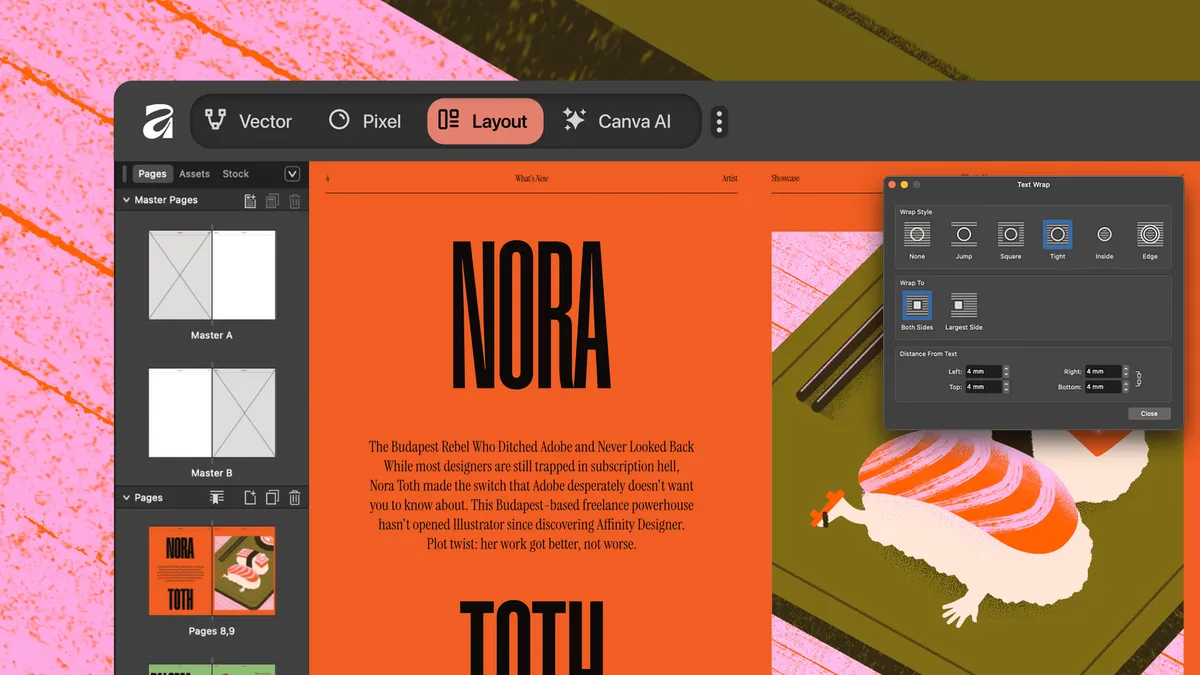
In October 2025, Canva made a bold move that sent shockwaves through the design software industry: the company announced Affinity is now “free forever,” merging the previously separate Affinity Photo, Designer, and Publisher into a unified all-in-one platform with AI Studio integration. This dramatic shift transforms Affinity from a $70-per-app professional tool into a completely free alternative to Adobe’s Creative Cloud, positioning Canva to capture millions of designers frustrated by Adobe’s subscription model while accelerating the company’s path toward a rumored IPO.
The Acquisition: March 2024
Canva Buys Affinity for $380 Million
Canva acquired Serif (Affinity’s parent company) in March 2024 for approximately $380 million (~£300 million), bringing the professional-grade design suite into Canva’s ecosystem.
Affinity Before Acquisition:
- Affinity Photo: Professional photo editing (Photoshop alternative)
- Affinity Designer: Vector graphics and illustration (Illustrator alternative)
- Affinity Publisher: Page layout and publishing (InDesign alternative)
- Pricing: $69.99 per app (one-time purchase, no subscription)
- Target users: Professional designers, photographers, publishers
Canva’s Vision:
- Integrate professional tools into Canva’s freemium platform
- Challenge Adobe’s $17 billion design software empire
- Expand beyond social media graphics into professional workflows
October 2025: The Free Forever Announcement
Unified Platform Launch
What Changed:
Before:
- Three separate applications (Photo, Designer, Publisher)
- $70 one-time payment per app
- Standalone desktop software
After (October 2025):
- Single unified application combining all three tools
- Completely free (no subscription, no one-time fee)
- Universal file type: Seamless switching between editing modes
- AI Studio integration: Canva’s AI tools built-in
Universal File Format: The new Affinity app uses a single file type that supports:
- Photo editing: Layers, adjustments, retouching
- Vector design: Bezier paths, shapes, typography
- Page layouts: Multi-page documents, master pages
Example Workflow:
- Open a photo in Affinity
- Edit and retouch (Photo mode)
- Add vector graphics and typography (Designer mode)
- Create multi-page brochure layout (Publisher mode)
- All in one file, no importing/exporting between apps
AI Studio Integration
Canva’s AI Tools Merged:
- Background removal: AI-powered instant background deletion
- Generative Fill: Expand images, fill gaps, remove objects
- Smart resize: Adapt designs to different dimensions
- Content-aware editing: Intelligent healing and cloning
- Style transfer: Apply artistic styles to photos
Professional + AI Workflow: Designers can combine professional manual control (Affinity’s strength) with AI acceleration (Canva’s innovation), creating a best-of-both-worlds experience.
Example:
- Photographer imports raw photo
- Manual color grading and retouching (Affinity Photo)
- AI removes distracting background elements (Generative Fill)
- Add vector logo and typography (Affinity Designer)
- Export for print or digital use
Direct Challenge to Adobe Creative Cloud
The Subscription Problem
Adobe’s Model:
- Creative Cloud All Apps: 720/year)
- Individual apps: $22.99-31.49/month per app
- Photographer plan: $19.99/month (Photoshop + Lightroom)
- Total lifetime cost: 7,200**
User Frustrations:
- Perpetual payments: Never “own” the software
- Price increases: Adobe raises prices regularly
- Forced upgrades: Must stay subscribed to access files
- Feature bloat: Paying for unused features
Affinity’s Disruptive Alternative
Original Affinity Advantage (pre-acquisition):
- One-time purchase: $70 per app, own forever
- No subscription: No recurring fees
- Lifetime cost: 7,200+ for Adobe over 10 years
Post-Canva Affinity:
- Free forever: $0 cost
- Unified platform: No need to buy separate apps
- AI enhancements: Modern features Adobe users pay premium for
Savings for Professionals:
- Individual designer: Save $720/year (Adobe All Apps cost)
- 5-person studio: Save $3,600/year
- Educational institution (100 licenses): Save $72,000/year
Feature Comparison
| Feature | Adobe Creative Cloud | Affinity (Canva) |
|---|---|---|
| Photo Editing | Photoshop | Affinity Photo (free) |
| Vector Design | Illustrator | Affinity Designer (free) |
| Page Layout | InDesign | Affinity Publisher (free) |
| AI Tools | Adobe Firefly ($20+/month extra) | AI Studio (included free) |
| Cloud Storage | 100GB-10TB (varies by plan) | Canva cloud integration |
| Pricing | $59.99/month | Free |
Canva’s Strategic Play
The Freemium Flywheel
How Canva Monetizes Free Affinity:
1. Premium Canva Features:
- Free Affinity users discover Canva’s ecosystem
- Upgrade to Canva Pro ($14.99/month) for advanced features:
- Brand kits and templates
- Content Planner
- Unlimited cloud storage
- Advanced AI tools
2. Team Collaboration:
- Design teams use Affinity for creation
- Collaborate via Canva Teams ($30/user/month)
- Real-time collaboration
- Version control
- Asset management
3. Print Services:
- Designers create in Affinity
- Order prints directly through Canva
- Canva earns margin on printing and fulfillment
4. Stock Assets:
- Premium photos, illustrations, templates
- Subscription-based or pay-per-use
Ecosystem Lock-In: By making Affinity free, Canva gets designers into the ecosystem, where monetization happens through adjacent services rather than software licenses.
IPO Preparation
Canva’s Valuation Trajectory:
- 2021 valuation: $40 billion
- 2024 (Affinity acquisition): ~$25 billion (market correction)
- 2025 target: Return to $40B+ ahead of IPO
Free Affinity’s Role:
- User growth: Attract millions of Adobe-frustrated designers
- Platform narrative: Position as comprehensive creative platform, not just graphics tool
- Revenue diversification: Demonstrate monetization beyond core Canva subscriptions
- Competitive moat: Make Adobe’s entry into Canva’s market harder
IPO Timeline (rumored):
- 2026-2027: Public offering likely
- Affinity: Proof of successful M&A integration and market expansion
Who Benefits?
1. Independent Designers and Freelancers
Scenario: Freelance graphic designer
- Adobe costs: $720/year (Creative Cloud All Apps)
- Affinity solution: Free → reinvest $720 in marketing, equipment, training
Business Impact:
- Lower overhead enables competitive pricing
- More profit margin on projects
- Easier to enter market without capital barriers
2. Educational Institutions
Scenario: Design school with 200 students
- Adobe costs: 47,976/year**
- Affinity solution: Free → redirect budget to equipment, guest speakers, scholarships
Educational Impact:
- Broader access to professional tools
- Students trained on industry-capable software
- Reduced financial burden on institutions
3. Small Businesses and Startups
Scenario: Startup marketing team (5 people)
- Adobe costs: 3,600/year**
- Affinity solution: Free → allocate budget to ads, content creation
Startup Impact:
- Professional design capabilities from day one
- Lower burn rate in early stages
- Compete with larger companies on visual quality
4. Developing Regions
Scenario: Designer in country with lower purchasing power
- Adobe costs: Often 30-50% of monthly income in some regions
- Affinity solution: Free, eliminating piracy incentive
Global Impact:
- Democratized access to professional design tools
- Reduced software piracy
- Empowered creative economies in emerging markets
Adobe’s Response
Immediate Reactions
Adobe has not issued official statement on Canva’s Affinity announcement, but industry observers note:
Potential Responses:
1. Pricing Adjustments:
- Introduce lower-cost tiers for individuals
- Student/education discounts expansion
- Bundling strategies to increase perceived value
2. AI Differentiation:
- Emphasize Adobe Firefly’s superiority
- Exclusive AI features for Creative Cloud
- Generative AI as moat
3. Enterprise Focus:
- Double down on corporate contracts
- Emphasize collaboration and DAM (Digital Asset Management) tools
- Integration with Adobe Experience Cloud
4. Dismissal:
- Position Affinity as “prosumer” tool, not true professional software
- Emphasize Adobe’s ecosystem maturity and industry adoption
Long-Term Competitive Dynamics
Adobe’s Advantages:
- Established workflows: Decades of industry adoption
- Ecosystem integration: Creative Cloud apps work seamlessly together
- Advanced features: Photoshop/Illustrator still have feature depth edge
- Brand dominance: “Photoshop” is a verb; brand recognition unmatched
Affinity/Canva’s Advantages:
- Cost: Free vs. $720/year is compelling
- Modern AI: Canva’s AI tools are cutting-edge
- Unified platform: Seamless cross-app workflows
- No lock-in: Files exportable to standard formats
Likely Outcome:
- Adobe maintains enterprise/high-end: Hollywood, ad agencies, large corporations stay Adobe
- Canva captures mid-market: Freelancers, SMBs, education shift to Affinity
- Market expansion: Free tools bring new users into design software market
Limitations and Considerations
1. Feature Parity
Affinity’s Strengths:
- Core design, photo editing, and publishing features
- Professional-grade output and color management
- Excellent performance and stability
Adobe’s Edge Cases:
- 3D design (Photoshop, Substance)
- Video editing (Premiere Pro, After Effects)
- Advanced typography (InDesign)
- Automation (Actions, scripts, plugins)
Reality: For 80-90% of design tasks, Affinity matches or exceeds Adobe. For specialized workflows, Adobe still necessary.
2. Industry Standards
Adobe’s Lock-In:
- PSD, AI, INDD files: Industry-standard formats
- Job requirements: Employers often require Adobe experience
- Collaboration: Clients send Adobe files expecting compatibility
Affinity’s Approach:
- Adobe file import/export: Affinity opens and saves Adobe formats
- Compatibility: Not perfect but sufficient for most workflows
- Transition friction: Learning curve when switching
3. Ecosystem Maturity
Adobe’s 30+ Years:
- Extensive plugin ecosystem
- Comprehensive tutorials and training resources
- Industry certification programs
Affinity’s Growth:
- Smaller plugin library (though growing)
- Community-driven tutorials (fewer official resources)
- Less established training/certification paths
4. Canva’s Monetization
“Free Forever” Questions:
- Business model sustainability: How long can Canva subsidize free professional software?
- Feature degradation risk: Will premium features migrate to paid tiers?
- Acquisition integration: Will Affinity team maintain product quality under Canva?
Canva’s Commitment: Company executives emphasize “free forever” is genuine strategy, not bait-and-switch, but only time will reveal execution.
The Bigger Picture: Design Software Democratization
Trend Toward Free Professional Tools
Affinity joins growing movement:
- Figma: Free for individuals (acquired by Adobe, but forced to maintain free tier)
- DaVinci Resolve: Free professional video editing (Blackmagic Design)
- Blender: Free 3D creation suite (open source)
- GIMP/Inkscape: Long-standing open-source design tools
The Pattern: Companies offer professional-grade tools for free and monetize through:
- Premium features/subscriptions
- Hardware sales (Blackmagic)
- Services (printing, cloud storage, collaboration)
- Enterprise licensing
Adobe’s Vulnerability: As free alternatives approach feature parity, subscription fatigue and budget constraints drive designers toward alternatives.
AI as the New Differentiator
Thesis: As core design features become commoditized (everyone can do layers, vector editing, color correction), AI capabilities become the competitive battleground.
Canva’s Bet:
- AI Studio: Best-in-class AI tools attract and retain users
- Integrated experience: AI woven into design workflow, not separate add-on
- Continuous improvement: AI models improve faster than traditional feature development
Adobe’s Counter:
- Adobe Firefly: Generative AI suite
- Sensei: AI-powered automation across Creative Cloud
- Data advantage: Decades of Adobe Stock content for AI training
Winner: Likely both succeed in different segments, with AI quality determining who captures emerging users.
Conclusion: The End of the Design Software Subscription Era?
Canva’s decision to make Affinity free forever represents a watershed moment in design software history. For decades, Adobe’s subscription model seemed inevitable—professional tools require ongoing development, and subscriptions fund continuous improvement.
Canva’s Hypothesis: The freemium model works even for professional-grade software if you:
- Capture users with free, high-quality tools
- Monetize ecosystems through adjacent services
- Build network effects through collaboration and sharing
The Implications:
For Designers: Unprecedented access to professional tools without financial barriers.
For Adobe: Existential challenge to subscription model and market dominance, especially in mid-market and education.
For Canva: Bold bet that ecosystem monetization can sustain free professional software—validated or disproven over next 2-3 years.
For the Industry: Acceleration of design software democratization, AI-driven feature development, and platform consolidation.
Whether Affinity’s “free forever” promise proves sustainable depends on Canva’s ability to monetize designers through its broader ecosystem without degrading the core product. Early signs are promising—integration of AI Studio, unified platform, and Canva’s strong financials suggest genuine commitment.
One thing is certain: $720/year subscriptions just got a lot harder to justify when free alternatives reach professional quality. Adobe’s response in the coming months will determine whether Affinity becomes a footnote or the beginning of design software’s free era.
Download Affinity:
- Website: affinity.serif.com or canva.com/affinity
- Free forever (no subscription, no one-time fee)
- Available: macOS, Windows, iPad
Stay updated on the latest design tools, AI creativity, and software industry disruptions at AI Breaking.