
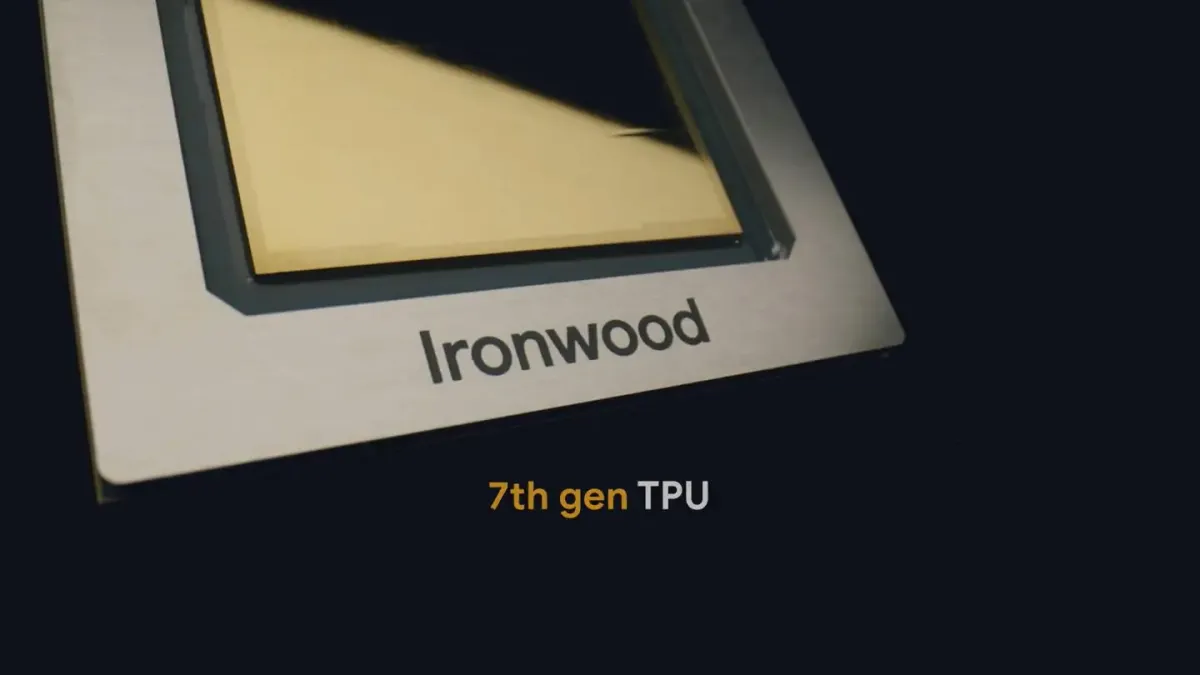
On November 6, 2025, Google Cloud announced the general availability of Ironwood, its seventh-generation Tensor Processing Unit (TPU)—marking Google’s most aggressive challenge yet to NVIDIA’s 90%+ dominance in AI chip markets. With performance more than 4x faster than the previous TPU v6e (Trillium) and 10x faster than TPU v5p, Ironwood scales to 9,216-chip pods delivering 42.5 exaflops of AI compute while consuming 30% less power per chip. The launch coincides with Anthropic’s commitment to use up to 1 million Ironwood TPUs (worth tens of billions of dollars), signaling that Google’s decade-long bet on custom silicon is finally paying off. As NVIDIA hits a $5 trillion market cap on the back of AI chip dominance, Google’s Ironwood represents the most credible alternative yet—threatening to fragment NVIDIA’s monopoly just as demand for AI infrastructure explodes.
Ironwood’s Specs: 4x Performance, 30% Less Power
The Technical Leap
Google Ironwood TPU (7th Generation):
| Metric | TPU v6e (Trillium) | Ironwood (v7) | Improvement |
|---|---|---|---|
| Peak Performance (per chip) | ~150 teraflops (FP8) | ~640 teraflops (FP8) | 4.3x faster |
| Performance vs. TPU v5p | 2x faster | 10x faster | 10x faster |
| Power Consumption | ~300W per chip | ~210W per chip | 30% reduction |
| Memory Bandwidth | 4.8 TB/s | 9.6 TB/s | 2x faster |
| On-Chip Memory (HBM) | 32 GB HBM2e | 64 GB HBM3e | 2x capacity |
| Interconnect | ICI (Inter-Chip Interconnect) | ICI v3 (3x bandwidth) | 3x faster |
| Pod Scaling | Up to 4,096 chips | Up to 9,216 chips | 2.25x larger |
Peak Pod Performance:
- Ironwood 9,216-chip pod: 42.5 exaflops (FP8 precision for AI training/inference)
- Comparable to: ~15,000 NVIDIA H100 GPUs in raw compute (though direct comparisons are workload-dependent)
What Is an Exaflop?
1 exaflop = 1 quintillion floating-point operations per second
- 42.5 exaflops = 42,500,000,000,000,000,000 calculations per second
- Frontier supercomputer (world’s fastest, U.S. Dept. of Energy): 1.2 exaflops (general-purpose compute)
- Ironwood pod: 35x more AI compute than Frontier (specialized for AI matrix math)
Why This Matters:
Training frontier AI models (GPT-5, Gemini 2.5, Claude Opus 4) requires exaflop-scale compute for months:
- GPT-5 training (estimated): ~50-100 exaflops sustained for 2-3 months
- Gemini 2.5 training: Similar scale
- A single Ironwood 9,216-chip pod can train a GPT-5-class model in 3-6 months
For inference (serving users):
- ChatGPT’s inference load: Estimated ~10-20 exaflops peak (300M weekly users, millions of concurrent queries)
- 2-4 Ironwood pods could theoretically handle ChatGPT’s entire global inference load
The Architecture: Why TPUs Are Different from GPUs
TPU vs. GPU: Designed for Different Jobs
NVIDIA GPUs (H100, Blackwell):
- Original purpose: Graphics rendering (3D games, video encoding)
- Adapted for AI: General-purpose parallel compute (CUDA)
- Strength: Flexible, handles diverse workloads (training, inference, graphics, crypto mining)
- Weakness: Not optimized specifically for AI matrix multiplication
Google TPUs (Ironwood):
- Original purpose: AI workloads only (designed in 2013 for Google Search, Translate)
- Specialized for: Matrix multiplication (the core operation in neural networks)
- Strength: 2-5x better performance per watt for AI-specific tasks (transformers, CNNs)
- Weakness: Can’t do graphics, gaming, or general compute—AI only
The Secret Sauce: Systolic Arrays
Ironwood’s Core Innovation:
TPUs use systolic arrays—a specialized hardware architecture optimized for matrix multiplication (the math underlying neural networks).
How It Works:
- Data flows like a heartbeat (hence “systolic”): inputs enter from one side, weights from another
- Every cycle, data moves to the next processing unit—no wasted clock cycles waiting for memory
- Result: Near-perfect utilization of silicon (vs. GPUs, which often idle waiting for data from memory)
Performance Impact:
- NVIDIA H100: Typically achieves 60-70% utilization during AI training (rest is waiting for data)
- Google Ironwood: Achieves 85-95% utilization due to systolic array + on-chip interconnects
This is why Ironwood is 4x faster despite similar transistor counts—the architecture is purpose-built for AI.
ICI v3 Interconnect: Scaling to 9,216 Chips
The Challenge of Multi-Chip Scaling:
Training large AI models requires tens of thousands of chips working in parallel. The bottleneck is chip-to-chip communication:
- Slow interconnects mean chips waste time waiting for data from neighbors
- Fast interconnects enable near-linear scaling (2x chips ≈ 2x performance)
Google’s Solution: ICI v3 (Inter-Chip Interconnect):
- Bandwidth: 3x faster than TPU v6e’s ICI
- Topology: 3D torus mesh—every chip connects to 6 neighbors (up/down, left/right, front/back)
- Latency: Sub-microsecond chip-to-chip communication
- Scaling: Enables 9,216 chips to act as a single giant processor
Comparison to NVIDIA:
- NVIDIA NVLink: Connects 8-16 GPUs efficiently, but scaling beyond 256 GPUs requires InfiniBand (slower, more expensive)
- Google ICI v3: Native support for 9,216 chips without external networking gear
Result: Google can build single training jobs across 9,216 Ironwood chips with near-linear scaling—hard for NVIDIA to match.
Anthropic’s 1 Million TPU Commitment: The Validation
The Biggest TPU Deal Ever
In October 2025, Anthropic announced it will use up to 1 million Google TPUs—mostly Ironwood chips—worth tens of billions of dollars. This is:
- Google’s largest single-customer TPU commitment ever
- Validation that Ironwood is production-ready for frontier AI training
- A direct challenge to NVIDIA’s H100/Blackwell dominance
Why Anthropic Chose TPUs:
- Price-Performance: Thomas Kurian (Google Cloud CEO) noted Anthropic saw “strong price-performance and efficiency” with TPUs
- Availability: NVIDIA H100s faced 12-18 month waitlists in 2023-2024—TPUs were available immediately
- Power efficiency: 30% lower power consumption = lower datacenter cooling costs
- Multi-cloud strategy: Anthropic uses Google TPUs + AWS Trainium + NVIDIA GPUs to avoid vendor lock-in
Anthropic’s Workload Split (Estimated):
- Google TPUs (1M chips): Primarily inference (serving 300,000+ customers) + supplemental training
- AWS Trainium + NVIDIA GPUs: Primary training clusters (Project Rainier)
Impact on Google Cloud:
- Tens of billions in revenue over 3-5 years
- Proves TPUs can compete head-to-head with NVIDIA at scale
- Attracts other AI labs: If Anthropic trusts TPUs, others will follow
Performance Benchmarks: Ironwood vs. NVIDIA vs. AMD
The AI Chip Showdown (November 2025)
| Chip | Peak Performance (FP8) | Power Consumption | Memory Bandwidth | Market Availability |
|---|---|---|---|---|
| Google Ironwood (TPU v7) | 640 teraflops | 210W | 9.6 TB/s | Google Cloud only |
| NVIDIA Blackwell B200 | 1,250 teraflops | 700W | 8 TB/s | Multi-cloud (AWS, Azure, GCP) |
| NVIDIA H100 | 500 teraflops | 700W | 3.35 TB/s | Multi-cloud |
| AMD MI300X | 480 teraflops | 750W | 5.3 TB/s | Multi-cloud |
| AWS Trainium2 | 350 teraflops | 550W | 4.8 TB/s | AWS only |
Performance per Watt (Efficiency):
- Ironwood: 3.05 teraflops/watt (640 ÷ 210)
- NVIDIA Blackwell: 1.79 teraflops/watt (1,250 ÷ 700)
- NVIDIA H100: 0.71 teraflops/watt (500 ÷ 700)
- AMD MI300X: 0.64 teraflops/watt (480 ÷ 750)
Ironwood is 1.7x more efficient than Blackwell, 4.3x more efficient than H100.
Real-World Performance: It’s Complicated
Raw teraflops don’t tell the whole story—real-world performance depends on:
- Software optimization: NVIDIA’s CUDA has 19 years of maturity—frameworks like PyTorch/TensorFlow are optimized for CUDA first
- Workload type: TPUs excel at transformers (LLMs, vision transformers), GPUs better at CNNs (image generation, video models)
- Scaling: TPUs’ ICI v3 interconnect enables better multi-chip scaling than NVLink for 1,000+ chip clusters
Benchmark Results (Google’s Claims):
- Gemini 2.5 Pro training on Ironwood: 2.5x faster than TPU v6e
- Inference latency on Ironwood: 35% lower than NVIDIA H100 for LLM inference
- Energy cost for training Gemini 2.0: 40% lower on Ironwood vs. NVIDIA H100 (due to power efficiency)
Independent Validation:
MLPerf benchmarks (industry-standard AI performance tests) for Ironwood are pending as of November 2025—Google typically submits TPU results 3-6 months after launch. Expect results in Q1 2026.
Google’s Decade-Long Bet: From Internal Tool to NVIDIA Challenger
The TPU Origin Story
2013: The Birth of TPUs
Google began designing TPUs internally to handle AI workloads for Google Search, Translate, and Photos. At the time:
- GPUs were too expensive (power costs) for Google’s scale (billions of queries/day)
- Google needed custom silicon optimized for inference (serving predictions to users)
2015: First TPU Deployed
Google quietly deployed first-generation TPUs in datacenters for RankBrain (AI-powered search ranking). This TPU was inference-only (couldn’t train models).
2016: Public Announcement
Google revealed TPUs at Google I/O 2016, positioning them as NVIDIA GPU competitors for AI inference.
2017: TPU v2 (Training Support)
Google launched TPU v2, the first TPU capable of training neural networks (not just inference). This enabled Google to train AlphaGo Zero, BERT, and Transformer models entirely on TPUs.
2018: Cloud Availability
Google Cloud began offering TPUs as a service—competing directly with AWS, Azure, and Google Cloud’s own NVIDIA GPU offerings.
2019-2024: Incremental Improvements
- TPU v3 (2019): 2x faster than v2
- TPU v4 (2021): 2x faster than v3 (used to train PaLM, Gemini 1.0)
- TPU v5p (2023): 4x faster than v4
- TPU v6e (Trillium, 2024): 2x faster than v5p, focused on cost-efficiency
2025: Ironwood (TPU v7)
The biggest generational leap yet—4x faster than v6e, 10x faster than v5p.
Why Now? The Timing of Ironwood
Google’s TPU strategy faces a critical moment:
- NVIDIA hit $5 trillion market cap—AI chip demand is exploding
- Anthropic, Meta, OpenAI, others are ordering hundreds of billions in NVIDIA GPUs
- Google risks losing cloud AI customers if TPUs can’t compete with NVIDIA’s Blackwell
Ironwood is Google’s answer: Prove that TPUs can match or beat Blackwell on performance and efficiency—and lock in customers like Anthropic for multi-year, multi-billion-dollar deals.
The Market Dynamics: Can Google Break NVIDIA’s Monopoly?
NVIDIA’s Dominance (90%+ Market Share)
Why NVIDIA Is Hard to Dethrone:
- CUDA lock-in: 19 years of ecosystem, millions of developers trained
- Multi-cloud availability: AWS, Azure, Google Cloud all offer NVIDIA GPUs—TPUs only on Google Cloud
- Flexibility: NVIDIA GPUs handle training, inference, graphics, HPC, crypto—TPUs are AI-only
- Software maturity: PyTorch, TensorFlow optimized for CUDA—TPU support is “good enough” but not equal
NVIDIA’s Response to Ironwood:
- Blackwell GPUs (B200, GB200): Launching Q4 2025, even faster than Ironwood (1,250 teraflops vs. 640)
- Price cuts unlikely: Demand far exceeds supply—NVIDIA has no incentive to discount
- Ecosystem expansion: NVIDIA is deepening CUDA integration with AI frameworks, making switching harder
Google’s Strategy: The “Good Enough” Alternative
Google doesn’t need to beat NVIDIA—just be competitive enough:
- Target workloads where TPUs excel: LLM training/inference, transformers, Google’s own products
- Price advantage: Offer 20-30% lower cost than NVIDIA GPUs on Google Cloud
- Vertical integration: Google controls entire stack (chips, datacenters, software)—can optimize end-to-end
- Sustainability angle: 30% lower power = better ESG credentials (environmental, social, governance)
Market Share Goals (Estimated):
- 2024: TPUs have ~10-12% of AI training market, ~15% of inference
- 2027 target: 20% of training, 25% of inference (if Ironwood succeeds)
This wouldn’t dethrone NVIDIA—but would:
- Prevent NVIDIA from extracting monopoly rents (keep prices competitive)
- Secure Google Cloud’s AI competitiveness vs. AWS, Azure
- Generate tens of billions in revenue from TPU sales
AWS, AMD, Intel: The Other Challengers
AWS Trainium/Inferentia:
- Strategy: Custom chips exclusively for AWS (no multi-cloud)
- Adoption: Amazon’s own models (Alexa, Rufus), some AWS customers
- Market share: ~5% training, 8% inference
AMD MI300X:
- Strategy: CUDA-compatible (ROCm software), multi-cloud
- Adoption: Meta, Microsoft (Azure), some enterprises
- Market share: ~7% training, 12% inference
- Challenge: ROCm still less mature than CUDA
Intel Gaudi 3:
- Strategy: Compete on price (cheaper than NVIDIA)
- Adoption: Limited (mostly Intel’s own customers)
- Market share: ~3% training, 5% inference
- Crisis: CEO departure, unclear future
Combined, all NVIDIA competitors have ~25% market share—NVIDIA still dominates at 75%.
Use Cases: Who Should Choose Ironwood Over NVIDIA?
Ideal Ironwood Customers
1. Google Cloud-Native Companies:
- Already use Google Cloud for compute, storage, databases
- Benefit: Tight integration with Vertex AI, BigQuery ML, Google Kubernetes Engine
- Example: Spotify (uses Google Cloud for music recommendations)
2. LLM-Focused Workloads:
- Training transformer models (GPT, BERT, T5 variants)
- Benefit: TPUs purpose-built for transformers—better efficiency than GPUs
- Example: Anthropic (Claude), Cohere (enterprise LLMs)
3. Cost-Conscious Enterprises:
- Need AI at scale but budget-constrained
- Benefit: 20-30% cheaper than NVIDIA on Google Cloud
- Example: Startups, academic research labs
4. Sustainability-Focused Organizations:
- ESG mandates require low-carbon AI
- Benefit: 30% less power = lower carbon footprint
- Example: European enterprises with strict climate regulations
When to Choose NVIDIA Instead
1. Multi-Cloud Strategy:
- Need to run on AWS, Azure, and Google Cloud
- NVIDIA wins: Available everywhere, TPUs only on Google Cloud
2. Diverse Workloads:
- AI training + inference + HPC + graphics rendering
- NVIDIA wins: GPUs are general-purpose, TPUs are AI-only
3. PyTorch-Heavy Development:
- Deep investment in PyTorch/CUDA codebases
- NVIDIA wins: CUDA maturity, though TPUs support PyTorch via XLA
4. Video/Image Generation:
- Diffusion models (Stable Diffusion, DALL-E, Sora)
- NVIDIA wins: GPUs historically better for CNNs/diffusion (though gap is narrowing)
Conclusion: Ironwood Won’t Dethrone NVIDIA, But It Doesn’t Have To
Google’s Ironwood TPU—with 4x performance gains, 30% lower power, and 9,216-chip scaling—is the most credible challenge to NVIDIA’s AI chip monopoly yet. With Anthropic’s 1 million TPU commitment and Google’s decade of silicon expertise, Ironwood proves that custom chips can compete with NVIDIA’s CUDA-powered empire.
Key takeaways:
- 4x faster than previous TPUs, 10x faster than v5p—leapfrog performance improvement
- 42.5 exaflops in 9,216-chip pods—enough to train GPT-5-class models
- 30% lower power consumption—sustainability and cost advantage
- Anthropic’s billion-dollar bet validates Ironwood for frontier AI
NVIDIA’s response: Blackwell GPUs still lead on raw performance (1,250 vs. 640 teraflops), but Ironwood wins on efficiency (3.05 vs. 1.79 teraflops/watt).
The reality: Google won’t dethrone NVIDIA—CUDA’s 19-year moat is too strong. But Ironwood achieves something equally valuable:
- Keeps AI chip prices competitive (prevents NVIDIA monopoly rents)
- Secures Google Cloud’s position in AI infrastructure wars vs. AWS, Azure
- Generates tens of billions in recurring revenue from TPU customers
- Proves custom silicon works—encouraging others (AMD, AWS, Meta) to invest in NVIDIA alternatives
For AI labs and enterprises: Ironwood offers a compelling alternative for LLM workloads on Google Cloud—especially for cost-conscious, sustainability-focused, or Google-native customers.
For NVIDIA: Ironwood is a warning shot—Google’s decade-long bet on TPUs is finally paying off, and the 90% market share monopoly may be unsustainable as custom silicon matures.
The AI chip wars are heating up—and Ironwood just threw down the gauntlet.