
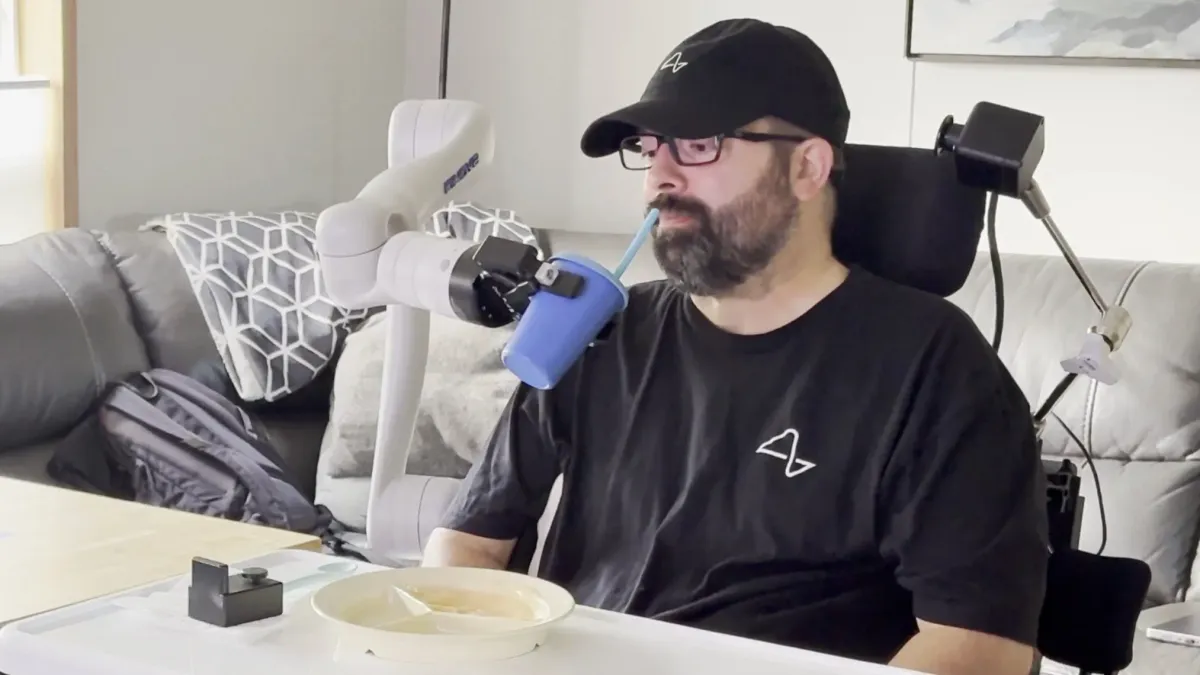
In a week described as “truly one for the books,” Neuralink participant Nick Wray achieved what many take for granted but what represents a profound restoration of independence: putting on his own hat, microwaving and eating his own chicken nuggets, opening his fridge, and manipulating jar lids—all controlled entirely by his thoughts through a brain-computer interface connected to an assistive robotic arm. These seemingly simple acts, accomplished over three consecutive 8-hour work sessions this week, mark a historic milestone in Neuralink’s mission to restore physical freedom to individuals with paralysis.
Hi everyone! Sorry for the late update. I’ll try to get back to Sundays.
— Nick Wray (@Telepath_8) October 5, 2025
TL;DR: !!!!!
This was truly a week for the books. I can’t remember the last time I put in a solid 8 hour work day and last week I put in 3 in a row. It was one of the most incredible experiences of my life
Daily Life Independence Restored
Three Days That Changed Everything
During Tuesday, Wednesday, and Thursday of last week, Nick worked with Neuralink’s Assistive Robotic Arm (ARA) team in what he called “one of the most incredible experiences” of his life. Over these three consecutive 8-hour sessions—the first time in years he’d worked full days—Nick accomplished milestones that represent genuine restoration of autonomy:
Personal Care:
- ✅ Put on his own hat for the first time in years
Food Preparation and Eating:
- ✅ Microwaved his own chicken nuggets
- ✅ Fed himself without assistance
Kitchen Navigation:
- ✅ Opened his refrigerator
- ✅ Removed and replaced lids on jars
These achievements represent the difference between dependence and dignity—between needing constant caregiver support and living independently.
Record-Breaking Dexterity Performance
Beyond everyday tasks, Nick also set new performance records demonstrating the precision and reliability of brain-controlled robotic manipulation:
Cylinder Transfer Test:
- 39 cylinders moved across a table in 5 minutes
- New record for the ARA system
Peg Flip Dexterity Test:
- 5 pegs flipped in standard dexterity test in 5 minutes
- Requires precise grip, rotation, and placement
These standardized tests allow researchers to quantify improvement over time and assess readiness for real-world deployment.
The Technology: Brain to Robotic Arm
Neuralink’s N1 Implant
Nick’s achievements are powered by Neuralink’s N1 brain-computer interface, a coin-sized device implanted in his motor cortex:
How It Works:
- Neural Recording: 1,024 electrodes detect activity from neurons that would normally control hand and arm movements
- Signal Transmission: Wireless transmission sends neural data to external computer
- Intent Decoding: Machine learning algorithms interpret intended movements from brain signals
- Robot Control: Decoded commands drive the Assistive Robotic Arm in real-time
- Feedback Loop: Visual feedback allows Nick to adjust and refine control
The Assistive Robotic Arm (ARA)
The ARA is Neuralink’s investigational robotic system designed specifically for restoring upper limb function:
Key Features:
- 6+ degrees of freedom: Mimics natural arm and hand movements
- Gripper with adjustable force: Can handle delicate (jar lids) and robust (refrigerator doors) tasks
- Real-time responsiveness: Low-latency control feels natural
Development Partnership: Neuralink is collaborating with Tesla’s robotics team (developers of Optimus humanoid robot) to leverage expertise in actuator design, sensor integration, and machine learning for control.
The CONVOY Study
Clinical Trial Framework
Nick’s accomplishments are part of Neuralink’s CONVOY feasibility study (CONtrol by neurallink Via Outside robotics):
Study Details:
- FDA Approved: November 2024
- Objective: Assess safety and functionality of N1 implant controlling assistive robotic arm
- Enrollment: Up to 5 participants
- Eligibility: Cervical spinal cord injury or ALS causing limited/no hand function
Cross-Enrollment: CONVOY allows cross-enrollment from the PRIME study (Neuralink’s primary BCI trial), meaning participants can seamlessly transition from cursor control to robotic arm control.
The Significance: From Lab to Life
Why This Week Matters
Nick’s three-day intensive represents a critical transition in brain-computer interface development:
From Demonstrations to Daily Use:
- Previous BCI achievements focused on proof of concept (moving a cursor, playing chess, writing text)
- Nick’s week demonstrates sustained, practical functionality for actual daily needs
From Single Tasks to Workflows:
- Opening a fridge → Removing a food item → Microwaving it → Eating it
- This multi-step workflow proves the system handles task sequences, not just isolated actions
Impact on Quality of Life
For individuals with paralysis, the ability to:
- Prepare and eat food independently eliminates reliance on meal delivery schedules
- Access their refrigerator enables spontaneous eating (snacks, drinks) rather than scheduled meals
- Manipulate containers (jars, bottles) restores agency in daily routines
- Put on clothing/accessories restores personal expression and dignity
The Path to Home Use
From Lab to Living Room
Neuralink’s ultimate goal is deploying robotic arms in patients’ homes for daily use:
Technical Requirements:
- Portability: Smaller, battery-powered robotic systems
- Ease of setup: Users/caregivers can position and calibrate without engineers
- Reliability: Operates without frequent maintenance or troubleshooting
Timeline Speculation: Based on typical medical device timelines:
- 2025-2026: Complete CONVOY feasibility study with 5 participants
- 2027-2028: Larger pivotal trial for FDA approval
- 2029-2030: Potential FDA approval and limited commercial launch
Broader Context: The BCI Race
Neuralink’s Competitive Position
Competitors with Robotic Arm Control:
- BrainGate (Brown University/VA): Decades of research, multiple patients with robotic arm control
- University of Pittsburgh: High-performance prosthetic limb control
- Blackrock Neurotech: Utah Array electrodes with robotic applications
Neuralink’s Advantages:
- High channel count: 1,024 electrodes vs. 100-200 for competitors
- Wireless design: No percutaneous connectors (infection risk)
- Robotic surgery: Precise, scalable implantation
- Vertical integration: Hardware, software, and robotics in-house
Conclusion
Nick Wray’s week of breakthroughs—putting on his own hat, cooking his own food, opening his fridge—represents far more than technological achievement. It’s the restoration of human dignity and independence to someone who’s lived without it for years. The three 8-hour days Nick spent mastering the Assistive Robotic Arm weren’t just research milestones—they were days he lived with agency, making choices about what to eat, when to eat it, and how to present himself to the world.
As Neuralink moves from feasibility studies to pivotal trials and, eventually, to FDA approval and home deployment, Nick’s achievements this week will be remembered as the moment brain-computer interfaces transitioned from impressive demonstrations to practical tools for daily life. The future where paralysis no longer means dependence—where thoughts become actions, and limitations become possibilities—is no longer science fiction.
It’s happening now, one chicken nugget at a time.
Stay updated on the latest brain-computer interface breakthroughs and neurotechnology advances at AI Breaking.